The Pressure Range (and Force Capabilities) of Electric Actuators
However, when we talk about "pressure range" in the context of electric actuators, what we're really referring to is their force or torque output — the ability to generate linear or rotary motion under load. Understanding this force range is essential for selecting the right actuator for your application, especially in industrial environments such as oil & gas, water treatment, chemical processing, and power generation.
Why “Pressure” Isn’t the Right Term – But Still Matters
In engineering terms, pressure is defined as force per unit area (e.g., psi or bar). It’s commonly used to describe the performance of pneumatic actuators, which depend on air pressure to move pistons or diaphragms.
Electric actuators, however, do not operate on compressed air. Instead, they are evaluated based on:
- Linear force (measured in Newtons or kilograms-force)
- Torque (measured in Newton-meters or pound-feet)
- Speed
- Positioning accuracy
Still, many engineers and procurement managers colloquially refer to these metrics as part of the "pressure capability" when comparing them with pneumatic systems. This terminology helps bridge the gap between legacy systems and newer electric solutions.
Types of Electric Actuators and Their Force/Torque Ranges
Electric actuators come in various forms and sizes, each designed for specific applications and performance requirements.
1. Linear Electric Actuators
Used primarily in applications requiring straight-line motion.
-
Miniature Linear Actuators:
- Force Range: 50 N – 2,000 N
- Voltage Range: 12V DC – 24V DC
- Applications: Medical beds, adjustable desks, robotics
-
Industrial Linear Actuators:
- Force Range: 2,000 N – 50,000+ N
- Voltage Range: 24V DC – 480V AC
- Applications: Valve automation, gate control, bulk material handling
These actuators often feature ball screws or lead screws to convert motor rotation into linear movement.
2. Rotary Electric Actuators
Designed for rotational tasks, such as opening and closing valves or dampers.
-
Quarter-Turn Actuators:
- Torque Range: 5 Nm – 5,000+ Nm
- Voltage Range: 24V DC – 230V AC
- Applications: Ball valves, butterfly valves, fire dampers
-
Multi-Turn Actuators:
- Torque Range: 100 Nm – 10,000+ Nm
- Voltage Range: 230V AC – 480V AC
- Applications: Gate valves, globe valves, sluice gates
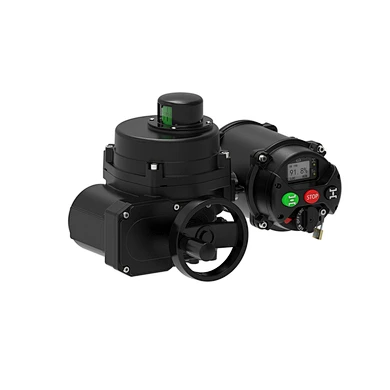
These actuators typically use worm gearboxes and position encoders to ensure accurate angular positioning.
What Influencing Force Output and Performance
Understanding the actual force or torque delivered by an electric actuator involves evaluating several interdependent factors:
1. Motor Power and Efficiency
Higher wattage motors can produce more torque but may require larger physical dimensions and cooling systems.
2. Gearbox Ratio
A higher gear ratio increases torque at the expense of speed. For example, a 100:1 gearbox will multiply torque by 100 but reduce output speed proportionally.
3. Duty Cycle and Load Conditions
Actuators must be rated for continuous or intermittent operation. Overloading beyond recommended limits can cause overheating or premature wear.
4. Environmental Conditions
Exposure to extreme temperatures, moisture, dust, or corrosive atmospheres can affect performance and longevity. Many industrial-grade electric actuators are rated IP67 or higher.
5. Control Systems and Feedback Mechanisms
Modern electric actuators often integrate position sensors, limit switches, torque monitoring, and communication protocols (Modbus, Profibus, HART). These features enhance reliability and enable predictive maintenance.
Comparing Table Electric vs. Pneumatic Actuators
| Feature | Electric Actuators | Pneumatic Actuators |
|---|---|---|
| Force Range | Up to 50,000 N / 5,000 Nm | Typically up to 20,000 N / 2,000 Nm |
| Precision Control | High (with feedback systems) | Moderate (limited by air compressibility) |
| Energy Efficiency | High (only consumes power when moving) | Low (requires constant compressor operation) |
| Maintenance Needs | Low | High (air filters, lubrication, regulators) |
| Installation Cost | Higher upfront cost | Lower initial cost, higher long-term cost |
| Safety in Hazardous Areas | Available with intrinsic safety ratings | Inherently spark-free, suitable for explosive environments |
While pneumatic actuators remain popular in hazardous environments due to their simplicity and lack of electrical components, electric actuators offer superior controllability, programmability, and integration with digital control systems.
Market Trends and Industry Adoption
According to recent market research reports, the global electric actuator market is expected to grow at a CAGR of over 6% from 2024 to 2030, driven by:
- Increased demand for smart manufacturing and Industry 4.0
- Expansion of renewable energy infrastructure
- Rising need for energy-efficient automation in process industries
- Growth in oil & gas pipeline automation projects
Companies are also investing heavily in wireless communication-enabled actuators, remote diagnostics, and AI-powered predictive maintenance tools.
How to Select the Right Electric Actuator Based on Force Requirements
Selecting the correct electric actuator requires careful analysis of the following:
- Load Type (static/dynamic, axial/radial)
- Required Torque or Force (including safety margin)
- Operating Voltage and Power Supply Availability
- Cycle Frequency and Duty Cycle
- Environmental Conditions
- Control System Compatibility
For example:
- A ball valve with a torque requirement of 800 Nm would require a mid-range quarter-turn actuator.
- A large gate valve needing 5,000 Nm of torque might necessitate a heavy-duty multi-turn actuator with explosion-proof housing and Modbus communication.
Using manufacturer-provided actuator sizing tools or selection software can help narrow down the best fit.
Electric Actuator Use in Pipeline Valve Automation
In a typical natural gas pipeline station, hundreds of isolation and control valves must be operated remotely. Traditionally, pneumatic actuators with I/P converters were used, but modern installations are increasingly adopting electric actuators due to:
- Elimination of compressed air infrastructure
- Integration with SCADA systems
- Improved positioning accuracy
- Reduced environmental footprint
One such installation in Southern Italy replaced all pneumatic actuators with Valen Tech rotary electric actuators, resulting in a 25% reduction in operational costs and improved system responsiveness.
Choosing the Right Electric Actuator for Your Application
While electric actuators don't operate on air pressure like pneumatics, understanding their force and torque capabilities is crucial for proper application fit. With a wide range of models available — from low-force linear actuators for furniture to high-torque rotary actuators for industrial valves — electric actuators provide unmatched flexibility, control, and efficiency.
At Valen Tech Co., Ltd., we specialize in delivering high-performance electric actuators tailored to meet the needs of demanding industrial environments. Our product line includes:
- Quarter-turn and multi-turn actuators
- Smart actuators with digital interfaces
- Explosion-proof and marine-rated options
- Custom-engineered solutions
Explore our full range of products at https://www.valen-tech.com/ or contact our team for expert consultation and actuator sizing support.