Why Choose a Double-Acting Actuator Over a Single-Acting One
Why Use a Double-Acting Actuator? Guide for Industrial Professionals
Pneumatic actuators are fundamental components in industrial automation, providing reliable and robust motion control across countless applications — from chemical processing plants to food and beverage production lines. When selecting an actuator, one of the most critical decisions is choosing between single-acting and double-acting designs.
While both types operate using compressed air — typically within the standard industrial range of 60–100 psi (4–7 bar) — their operational principles, performance characteristics, and suitability for specific applications differ significantly. This article dives deep into why a double-acting actuator is often the preferred choice in demanding environments where precision, force consistency, and long-term reliability are paramount.
What Is a Double-Acting Actuator?
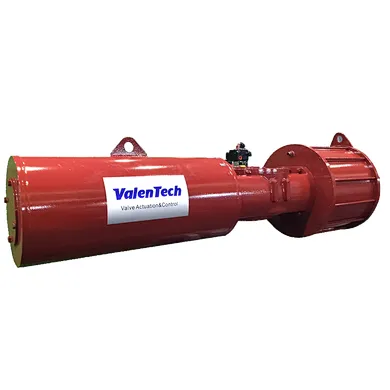
A double-acting pneumatic actuator uses pressurized air to generate mechanical movement in both directions: extending and retracting the piston or rotating the shaft. Unlike single-acting actuators that rely on a spring to return to a home position, double-acting models have two separate air ports:
- One port receives compressed air to drive the actuator into its working stroke (e.g., opening a valve).
- The second port receives air to reverse the motion (e.g., closing the valve).
This bidirectional power delivery ensures that full system pressure — commonly supplied at 60–100 psi — is applied during both phases of operation. As a result, the actuator delivers consistent, high-force output regardless of direction.
Double-acting actuators are available in both linear (piston-cylinder) and rotary (rack-and-pinion, scotch yoke) configurations, making them versatile for a wide range of industrial tasks.
How Does a Double-Acting Actuator Work?
The internal mechanism of a double-acting actuator revolves around a sealed cylinder containing a piston connected to a rod or gear train. Compressed air alternately enters either side of the piston via a directional control valve (typically a 5/2-way solenoid valve), creating differential pressure that forces the piston to move.
Here’s how it works step by step:
- Extension Stroke: Air is directed into the "cap end" of the cylinder, pushing the piston forward.
- Retraction Stroke: Simultaneously, air on the opposite side (rod end) is exhausted. To reverse the motion, air is then supplied to the rod end while exhausting the cap end, pulling the piston back.
- Control Mechanism: A 4-way directional control valve manages this airflow, ensuring precise sequencing and preventing cross-flow between ports.
Because there is no reliance on springs, all energy for motion comes directly from the compressed air supply. This allows for faster response times, higher cycle rates, and more predictable performance under variable loads.
In rotary configurations like rack-and-pinion actuators, the linear motion of the piston is converted into rotational torque through meshed gears, enabling quarter-turn valve automation with equal force in both open and close directions.
Why Choose a Double-Acting Actuator Over a Single-Acting One?
Choosing between single-acting and double-acting actuators hinges on application requirements, safety protocols, and process dynamics. While single-acting actuators offer inherent fail-safe functionality due to their spring-return design, they come with significant trade-offs in performance and longevity.
Double-acting actuators eliminate these compromises by offering:
- Full pneumatic force in both directions
- Elimination of spring fatigue and degradation
- Greater flexibility in mounting orientation
- Higher efficiency in high-cycle operations
For systems where process continuity, bidirectional force, and long service life are priorities, double-acting actuators provide superior engineering value. They are particularly well-suited for automated processes that require frequent modulation, tight sealing against backpressure, or integration with advanced control systems.
Moreover, because they do not depend on mechanical springs, double-acting actuators can be designed more compactly for the same torque output, allowing space-constrained installations without sacrificing performance.
Do Double-Acting Actuators Provide More Force?
Yes — and critically, they deliver balanced, maximum force in both directions, which is a key advantage over single-acting designs.
In a typical single-acting actuator:
- The outward stroke (e.g., opening a valve) is powered by air pressure (60–100 psi).
- The return stroke relies on a pre-compressed spring, which must be strong enough to overcome friction and load resistance.
However, spring force diminishes as it extends, following Hooke’s Law (F = kx), meaning the return force decreases throughout the stroke. Additionally, springs degrade over time due to metal fatigue, temperature exposure, and corrosion, leading to inconsistent performance and eventual failure.
In contrast, a double-acting actuator applies full line pressure to both strokes, resulting in:
- Equal thrust/torque in extension and retraction
- Consistent force profile across the entire stroke length
- No loss of return capability over time
This makes double-acting actuators ideal for applications involving:
- High backpressure (common in oil & gas pipelines)
- Tight-shut valves requiring positive closure force
- Systems with sticky or viscous media that increase resistance
By maintaining full air-powered force in both directions, double-acting actuators ensure reliable valve seating and prevent leakage — a critical factor in process integrity and environmental compliance.
Are Double-Acting Actuators Better for High-Cycle Applications?
Absolutely — and here's why they outperform single-acting models in fast-cycling or continuous-duty scenarios.
High-cycle applications — such as packaging machines, bottling lines, or automated assembly systems — demand thousands of cycles per day. In these environments, mechanical wear becomes a primary concern.
Single-acting actuators subject their internal springs to constant compression and decompression. Each cycle stresses the spring material, leading to:
- Progressive loss of spring tension
- Increased risk of fracture or buckling
- Reduced return speed and incomplete actuation
Over time, this results in maintenance downtime, increased spare parts inventory, and potential process interruptions.
Double-acting actuators avoid this entirely by eliminating the spring. Instead, they use air pressure for every movement, distributing stress evenly across durable seals and bearings. Modern elastomeric seals and hard-coated pistons further enhance longevity, even under aggressive cycling conditions.
Additionally, double-acting actuators respond faster to control signals because:
- There is no spring inertia to overcome
- Air pressure can be modulated rapidly via solenoid valves
- Return speed matches extend speed, improving cycle symmetry
This translates to higher throughput, better timing accuracy, and reduced energy waste — all crucial factors in competitive manufacturing environments.
Can You Use a Double-Acting Actuator for Modulating Control?
Yes — and when paired with the right instrumentation, double-acting actuators excel in proportional or modulating control applications.
Modulating control requires an actuator to move to any intermediate position between fully open and fully closed, based on a dynamic input signal. This is common in flow regulation, temperature control, pressure management, and level control loops.
To achieve this, double-acting actuators are typically equipped with a pneumatic positioner, which receives a low-pressure control signal — most commonly the industry-standard 3–15 psi pneumatic signal.
Here’s how it works:
- The control system (e.g., a pneumatic controller or I/P transducer) sends a 3–15 psi signal to the positioner.
- At 3 psi, the positioner commands the actuator to move to the 0% position (e.g., fully closed).
- At 15 psi, it commands 100% travel (fully open).
- Intermediate signals (e.g., 9 psi = 50%) allow precise positioning anywhere in between.
The positioner dynamically adjusts airflow to both sides of the piston, maintaining the exact position despite changes in load, friction, or upstream pressure. Because double-acting actuators apply active force in both directions, they resist drift and maintain stability far better than spring-return types, especially under unbalanced forces.
Even in modern plants using electronic signals (like 4–20 mA), the final interface to the actuator often involves converting the signal to a 3–15 psi command via an I/P transducer, proving the enduring relevance of this pneumatic standard.
Do Double-Acting Actuators Have a Fail-Safe Function?
No — not inherently. This is a crucial distinction that impacts safety system design.
If the compressed air supply fails, a double-acting actuator will typically remain in its last position ("fail-last" or "fail-in-place"). It cannot automatically move to a safe state because it lacks a stored energy mechanism like a spring.
In contrast, single-acting actuators are often used in safety instrumented systems (SIS) because they can be engineered to:
- Fail-open: Spring returns the valve to open on air loss (e.g., cooling water valves)
- Fail-closed: Spring closes the valve (e.g., fuel shutoff valves)
However, this doesn't mean double-acting actuators can't be part of a safe system. With proper engineering, they can be integrated into fail-safe strategies using:
- Air reservoirs or accumulators: Store pressurized air to power the actuator during a supply failure.
- Solenoid valves with latching logic: Automatically vent or redirect air upon signal loss.
- Hybrid electro-pneumatic controls: Use backup power to initiate a controlled shutdown.
These solutions add complexity and cost but allow engineers to leverage the performance benefits of double-acting actuators while meeting functional safety requirements (e.g., SIL-rated systems).
Therefore, the decision often comes down to a risk assessment: Is automatic fail-safe action required, or is holding position acceptable or even preferable?
Are Double-Acting Actuators Suitable for Hazardous Environments?
Yes — and in many cases, they are preferred in hazardous locations due to their intrinsic safety.
Pneumatic systems produce no electrical sparks, making them inherently safe for use in environments classified under NEC/CEC or ATEX standards where flammable gases, vapors, or combustible dusts may be present (e.g., oil refineries, grain silos, paint booths, pharmaceutical facilities).
Since double-acting actuators operate purely on compressed air — including for return motion — they maintain this spark-free advantage throughout their operation. They do not require motors, encoders, or electronic controllers unless integrated with digital positioners.
Furthermore, pneumatic components are generally:
- Resistant to electromagnetic interference (EMI)
- Tolerant of extreme temperatures
- Immune to voltage surges and grounding issues
This ruggedness makes them ideal for harsh industrial settings where electronic actuators might fail prematurely.
That said, all components — including tubing, fittings, and control valves — must be rated for the intended environment, and proper installation practices (e.g., grounding for static discharge) should be followed.
When Should You Choose a Double-Acting Actuator?
You should select a double-acting actuator when your application prioritizes any of the following:
- ✅ Equal and maximum force in both directions
- ✅ High-frequency cycling or continuous operation
- ✅ Precise modulating or throttling control
- ✅ Operation under high backpressure or resistant loads
- ✅ Long-term reliability without spring degradation
- ✅ Integration with 3–15 psi pneumatic control systems
Common industries and use cases include:
- Oil & gas pipeline isolation valves
- Chemical reactor feed control
- Water treatment plant sluice gates
- Power plant boiler dampers
- Food processing line diverters
- Pharmaceutical cleanroom isolators
Conversely, if your system requires automatic fail-safe operation (e.g., emergency shutdown), and you cannot justify the added complexity of backup systems, a spring-return (single-acting) actuator remains the simpler, safer choice.
Ultimately, the selection should be based on a thorough analysis of process requirements, safety protocols, maintenance capabilities, and lifecycle costs.
Need Help Choosing the Right Pneumatic Solution?
At Valen Tech Co., Ltd., we specialize in delivering high-performance pneumatic actuators engineered for real-world industrial challenges. Whether you need robust double-acting models for continuous-duty automation or integrated solutions with positioners and control valves, our team provides expert guidance and customized support.
? Explore our full range of pneumatic actuators
? Contact us for technical consultation or system integration
From concept to commissioning, Valen Tech is your trusted partner in intelligent, reliable automation.