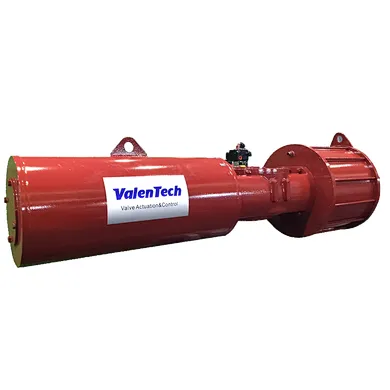
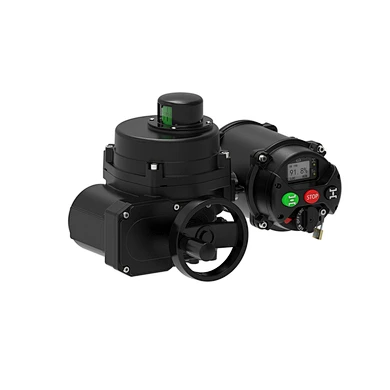
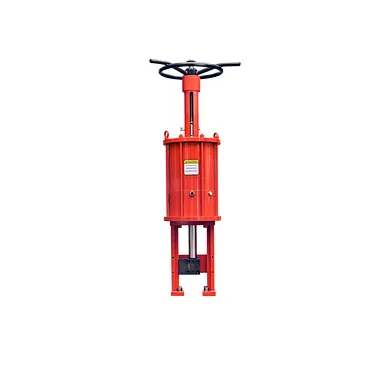
What is the pressure range for pneumatic actuators?

What's the Typical Pressure Range for Pneumatic Actuators?
Pneumatic actuators are the workhorses of countless automated systems, from factory floors to amusement park rides. They convert the energy of compressed air into simple, reliable linear or rotary motion – the "push and pull" that makes things happen. But just how much pressure do these handy devices need to get the job done?
While pneumatic actuators can be designed to operate under various conditions, there's a very common and standard pressure range you'll encounter in most industrial and commercial applications.
The Industrial Sweet Spot: 60 to 100 psi
The vast majority of standard industrial compressed air systems operate within a range that's ideal for pneumatic actuators:
-
In imperial units: 60 to 100 psi (pounds per square inch)
-
In metric units: Approximately 4 to 7 bar (or 400 to 700 kPa)
This range is considered the "sweet spot" for several practical reasons:
-
Force Production: Within this pressure range, standard-sized actuators can generate significant force for typical automation tasks without needing to be excessively large or heavy.
-
Compressor Efficiency: Air compressors designed for this pressure range are widely available, relatively energy-efficient for the power they provide, and cost-effective to install and maintain.
-
Component Availability: Regulators, valves, tubing, fittings, and other pneumatic components are readily available and standardized for operation within this pressure band.
-
Safety: While still requiring respect, pressures in this range are more manageable and less inherently hazardous than very high pressures.
Below the Minimum?
While an actuator might start to move at pressures lower than 60 psi, reliable and consistent operation is typically compromised below a certain point. Many actuators need a minimum pressure, often in the 40 to 60 psi (2.5 to 4 bar) range, just to overcome internal friction and the weight of the load. Below this, movement might be slow, weak, or simply not happen at all.
Going Higher
For applications requiring exceptional force from a smaller footprint, pneumatic systems can be designed to operate at higher pressures, sometimes reaching 150 psi (around 10 bar) or even slightly more. However, this is less common for general automation.
Operating at these higher pressures requires:
-
Specialized, heavy-duty compressors.
-
Actuators, valves, and components specifically rated for the higher pressure.
-
Enhanced safety precautions due to the increased energy stored in the compressed air.
Why Knowing the Pressure Matters
Understanding the typical pressure range is crucial. If a pneumatic actuator isn't performing correctly (slow, weak, not moving), one of the first things to check is the incoming air pressure. Is it within the actuator's specified operating range? Is the pressure stable? Low pressure is a very common cause of poor actuator performance, and it points to an issue with the air supply system, not necessarily the actuator itself.
In conclusion, while variations exist for specialized tasks, you can confidently assume that most Pneumatic actuators in standard industrial settings are designed to thrive on compressed air supplied within the 60 to 100 psi (4 to 7 bar) range, providing reliable power for countless automated motions.
What is the standard PSI for a pneumatic signal?
When we talk about pneumatic systems, we often think about the powerful "push" or "pull" that makes machines move – the job of the actuator powered by pressures typically ranging from 60 to 100 PSI. But compressed air isn't just used for brute force; it also has a language of its own, used to communicate commands and information within control systems.
This "language" is transmitted via what's known as a pneumatic signal, and it operates at a much lower, standardized pressure range.
The Established Standard: 3 to 15 PSI
For decades, the industry standard pressure range for a pneumatic control signal has been 3 to 15 PSI (pounds per square inch).
Here's how this range functions as a communication scale:
-
3 PSI: Represents the lowest possible value or the "zero point" of the signal. Think of it as indicating 0% of something – like a valve being fully closed, or a measured variable (temperature, pressure, flow) being at its minimum value.
-
15 PSI: Represents the highest possible value or the "maximum point" of the signal. This corresponds to 100% of something – like a valve being fully open, or a measured variable being at its maximum expected value.
This creates a 12 PSI span (15 - 3 = 12) that allows for proportional control. A pressure signal anywhere between 3 and 15 PSI corresponds to a specific percentage within that range. For example:
-
A 9 PSI signal is exactly halfway between 3 and 15, so it represents 50% of the control range.
-
A 6 PSI signal represents 25% of the range.
-
A 12 PSI signal represents 75% of the range.
Signal Air vs. Power Air: Don't Get Them Confused!
This is a crucial distinction. The 3-15 PSI signal air is not typically the air that directly moves a large actuator. It's a low-pressure command signal used to control other devices, such as:
-
Valve Positioners: These devices receive the 3-15 PSI signal and use it to regulate the flow of the higher-pressure power air (60-100+ PSI) to a valve actuator, moving the valve to the position commanded by the signal.
-
Pneumatic Controllers: Older style controllers that use air pressure for logic and calculations.
-
Pneumatic Relays and Transducers: Devices that convert the pneumatic signal or use it to trigger other actions.
Think of the 3-15 PSI signal as the detailed instruction from the brain (controller), and the 60-100 PSI air as the muscle power. The instruction tells the muscle how much force to apply or how far to move.
Why This Standard?
The 3-15 PSI standard became widely adopted for several reasons:
-
It was an early and effective standard for pneumatic control systems, leading to widespread adoption and compatible equipment.
-
Pneumatic systems are inherently rugged and less susceptible to electrical noise, making them suitable for harsh industrial environments.
-
Unlike electrical signals, pneumatic signals don't produce sparks, making them ideal for use in areas where flammable gases or dust are present.
-
While complex pneumatic logic exists, the basic 3-15 PSI signal is a simple, direct way to represent a variable or command percentage.
While newer industrial systems often utilize electronic signals (like 4-20mA current loops) or digital communication networks (like Ethernet/IP or PROFINET), the 3-15 PSI pneumatic signal remains a fundamental standard and is still widely encountered in existing process control plants and specific niche applications where its advantages are beneficial.
So, the next time you encounter a pneumatic system, remember that besides the high-pressure air providing the muscle, there might be a lower-pressure, standardized 3-15 PSI signal quietly communicating the precise instructions.
Valen Tech Co., Ltd.
At Valen Tech Co., Ltd. , we are committed to delivering innovative technological solutions that drive progress across industries. As a forward-thinking technology company, we specialize in providing high-quality products, customized engineering services, and advanced system integration tailored to meet the evolving needs of our global clients.