
Application of Electric Actuators in Petrochemical and Water Treatment Industries
author: ATHENA GROUP
2026-07-11

Petrochemical production generates large volumes of wastewater containing oil and chemical pollutants. Efficient water treatment serves as a critical guarantee for enterprises to realize safe production, compliant wastewater discharge and green low-carbon development. Petrochemical water treatment covers multiple procedures including raw water purification, wastewater treatment, circulating water regulation and tailwater discharge. Each procedure imposes stringent requirements on the control accuracy and reliability of flow rate, pressure and liquid level. As the core execution unit of industrial automatic control systems, electric actuators convert electrical signals into mechanical motions to realize the opening, closing and regulation of valves. Featuring outstanding adaptability to harsh working conditions, electric actuators have become essential equipment for the intelligent upgrading of petrochemical water treatment systems.
I. Core Characteristics and Application Advantages
Composed of a motor, reducer, intelligent controller and precision positioning module, electric actuators receive instructions from PLC, DCS and SCADA systems to precisely regulate various industrial valves. They are mainly categorized into three types: multi-turn, part-turn and linear stroke. Compared with pneumatic and hydraulic equipment, electric actuators require no supporting air sources or hydraulic pipelines, featuring a simpler structure and stronger controllability.
Their core advantages are highly compatible with petrochemical water treatment working conditions: high-precision valve regulation capability to stabilize various process parameters of water treatment; built-in anti-interference design to resist electromagnetic interference, temperature fluctuations and equipment vibration for stable operation; anti-corrosion stainless steel materials and protective coatings adopted for equipment, with the protection grade of most models reaching IP68, suitable for humid and corrosive working conditions. In addition, they feature convenient installation, simple maintenance and low operating energy consumption, which can effectively reduce enterprises’ long-term operating costs.
II. Core Applications in Petrochemical Production
Petrochemical sites feature special working conditions such as high pressure, high temperature and flammable & explosive media, which impose extremely high safety standards on control equipment. In pipeline transportation scenarios, electric actuators dynamically regulate medium pressure and flow rate to avoid water hammer effects and medium leakage. Equipped with an emergency cut-off function, they can rapidly isolate hazardous media to guarantee the safe operation of pipe networks.
During refining and chemical production, precise parameter regulation stabilizes core processes including distillation, chemical reactions and material separation. Remote automatic operation reduces on-site manual work and eliminates potential safety hazards caused by chemical medium leakage. Electric actuators with explosion-proof certifications are widely applied in scenarios such as storage tanks, production workshops and delivery pump stations. Free from air source faults common to pneumatic equipment, they can operate stably under extreme petrochemical working conditions.
III. Full-Process Applications in Water Treatment
Raw Water Pretreatment
Electric actuators control inlet valves and filter valves to adjust water flow according to water quality and operating load, stabilizing filtration and sedimentation effects and ensuring the effluent quality of pretreatment meets standards.
Oily Wastewater Treatment
Actuators precisely regulate chemical dosing valves, aeration valves and sludge discharge valves to optimize flocculation sedimentation, biochemical degradation and solid-liquid separation, greatly improving wastewater treatment efficiency.
Circulating Water Systems
Real-time regulation of flow rate and blowdown volume stabilizes water quality indicators, effectively preventing pipeline scaling and corrosion, reducing equipment loss and ensuring stable operation of production equipment.
Terminal Wastewater Discharge
Electric actuators interlock with online water quality monitoring devices to automatically start and stop discharge valves, intercepting substandard wastewater and supporting enterprises to achieve full environmental compliance.
IV. Equipment Selection and Operation Requirements
Petrochemical water treatment features complex and corrosive working conditions, so equipment selection must match actual working conditions: stainless steel anti-corrosion models are prioritized for acid and alkali corrosive environments; compliant explosion-proof actuators must be adopted in high-risk production areas; torque and stroke specifications shall be matched according to valve types and pipeline pressure.
Intelligent actuators compatible with intelligent control systems and equipped with fault self-diagnosis functions are preferred to meet automatic management demands. Meanwhile, regular equipment calibration and routine maintenance shall be carried out to ensure 24-hour continuous and stable operation of equipment.
V. Conclusion
Electric actuators deliver precise control, stable operation, reliable explosion-proof and anti-corrosion performance, alongside low operation and maintenance costs. They thoroughly resolve long-standing industry pain points of traditional control equipment such as low precision and poor stability, and are fully applicable to the full processes of petrochemical production and water treatment. By boosting the automation and refinement of processes, lowering energy consumption and operation & maintenance costs, and guaranteeing compliant wastewater discharge, electric actuators provide solid technical support for the intelligent, efficient and green low-carbon development of modern petrochemical industries. As a professional actuator brand with years of deep cultivation in the industrial control field, ValenTech has developed a series of high anti-corrosion, high explosion-proof and high-precision electric actuator products tailored to complex and harsh working conditions in petrochemical and water treatment sectors. These products can fully satisfy the stringent operational requirements of industries and help enterprises achieve safe production, efficient operation and maintenance, as well as green compliant manufacturing.
How Actuated Ball Valves Obtain Dual ATEX and IECEx Certifications for Hazardous Environments
What is an Explosion-Proof Electric Actuator? Principles, Features, Applications & Selection Guide
Related Article
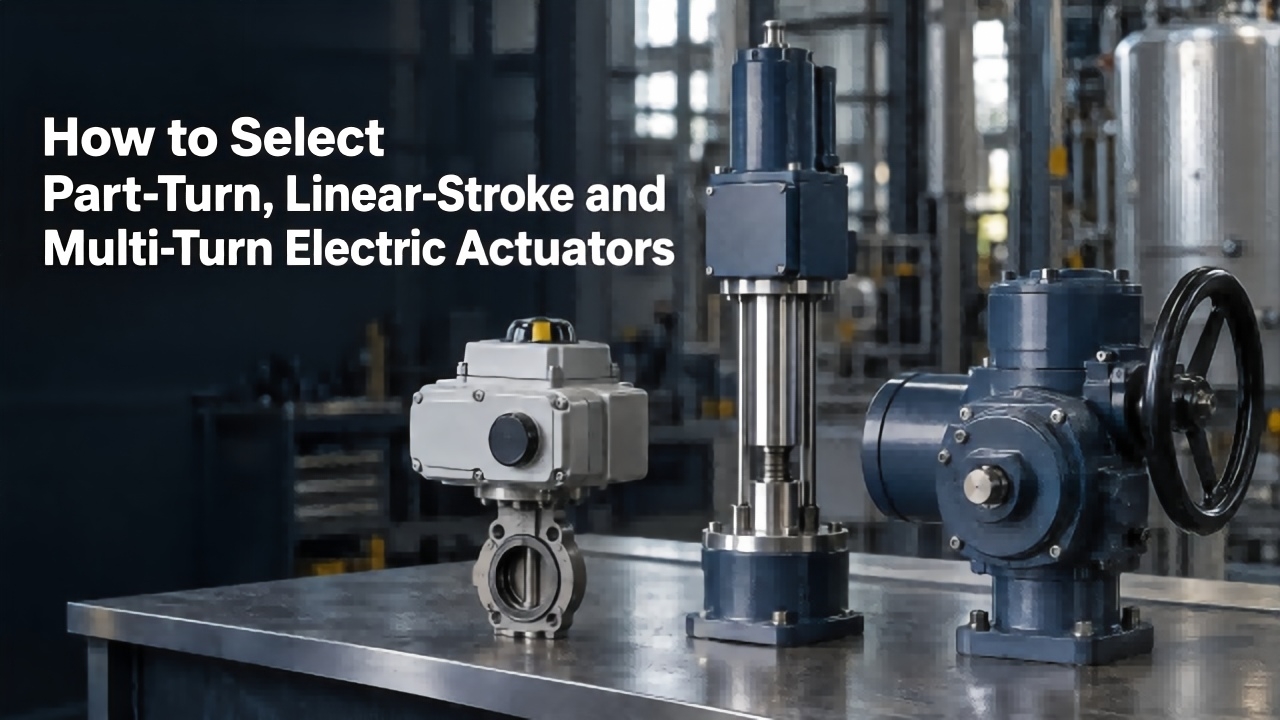
Learn differences among part‑turn, linear‑stroke and multi‑turn electric actuators. This guide covers matching valves, torque‑thrust calculation, 5‑step selection process and typical pitfalls for your industrial actuator applications.
How to Select Part‑Turn, Linear‑Stroke and Multi‑Turn Electric Actuators
Learn about electric actuator response speed, internal and external influencing factors and key selection points, to select suitable actuators for valve automation projects and ensure efficient and stable system operation.
Response Speed of Switch‑Type Electric Actuator
Valve Actuator Wiring describes wiring, commissioning and troubleshooting for electric valve actuators, guiding technicians to adopt standard wiring for stable industrial control.
Valve Actuator Wiring
Valen Tech explains electric valve actuator torque control and overload protection functions. Learn how multi‑turn & part‑turn actuators prevent jamming and mechanical damage for petroleum, chemical, power and water pipeline systems.
Introduction to Torque Control and Overload Protection Functions of Electric Valve Actuators