Scotch Yoke vs Rack and Pinion Actuators: Which Mechanism Fits Your Valve?
Choose wrong, and you get an actuator that is oversized for 80% of the stroke yet still unable to unseat the valve. Choose right, and the actuator, valve and spring all work as one system. This guide explains how each mechanism works, compares them head to head, and shows you how to match the mechanism to your valve's real torque demand.
How a Rack and Pinion Actuator Works
A rack and pinion actuator is the most common pneumatic quarter-turn actuator on the market, and its operating principle is easy to picture.
Compressed air acts on one or two opposed pistons inside a cylindrical housing. Each piston carries a rack — a straight bar with gear teeth cut along one edge. As the piston travels, the racks engage a central pinion gear mounted on the output shaft, and the linear piston motion becomes rotation of the shaft. Reverse the air pressure to one side of the pistons and the shaft rotates the other way.
Because the racks engage the pinion at a constant radius through the whole stroke, the output torque of a rack and pinion actuator is approximately flat — nearly constant from 0° to 90°. That predictability makes it simple to size, and the mechanism itself is mechanically straightforward: two pistons, two racks, one pinion, plus seals and end caps.
The practical consequences:
- Compact and light. The symmetrical, in-line cylinder design is space-efficient and easy to mount in tight locations.
- Lower cost. Fewer precision components and a mature manufacturing base make it the economical choice for general-purpose valve automation.
- Well proven in high-cycle service. Force is transmitted through gear teeth, a mechanism with decades of operating history in packaging, dosing, HVAC and process plants.
- Best suited to small and medium valves. In practice, rack and pinion actuators cover the most common range of quarter-turn automation — roughly from a few tens of N·m up to around 2,500 N·m, on valves typically up to DN200 (8″), depending on pressure class.
How a Scotch Yoke Actuator Works
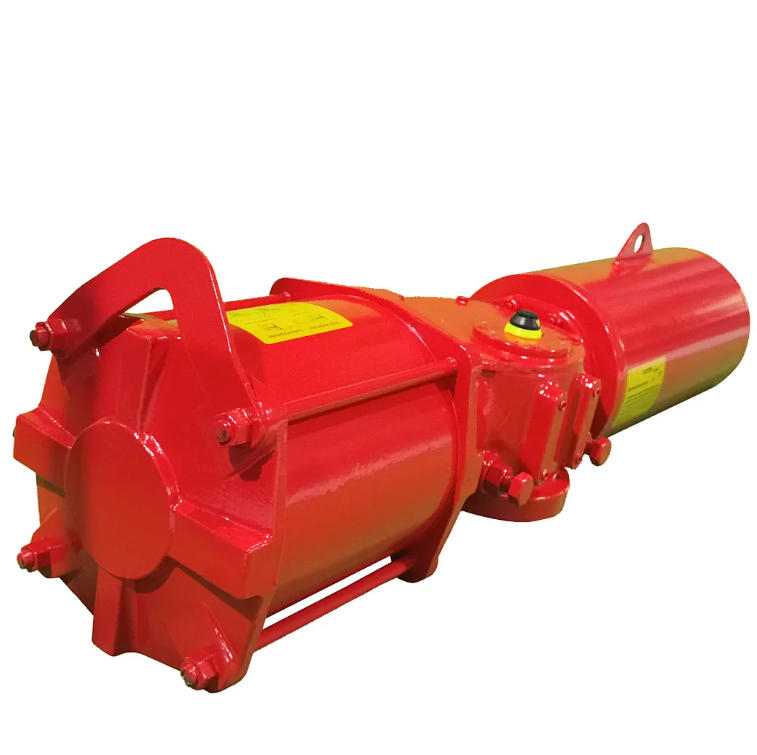
A scotch yoke actuator uses no gears at all. Instead, a guide pin mounted on the piston rod rides inside a slotted yoke (often called a fork) that is fixed to the output shaft. As the piston moves in a straight line, the pin is captured by the slot and forces the yoke — and therefore the valve stem — to rotate through its 90° arc. Linear motion becomes quarter-turn rotation through a single sliding mechanical link.
The defining characteristic is the torque curve. The output torque depends on the effective lever arm between the piston force line and the shaft axis, and that arm changes continuously as the yoke rotates. The result is a U-shaped (saddle) torque profile:
- Highest at 0° and 90° — at the closed and open end positions, where a seated valve needs the most force
- Lowest through mid-stroke — around 45°, where the valve is moving freely
A scotch yoke actuator also has a distinctive construction: a central yoke housing with a cylinder on one side and either a second cylinder (double acting) or a spring cartridge (spring return) on the other. Inside, the piston rod drives a sliding block along a guide rod, and the block engages the fork on the output shaft. This layout is longer and often asymmetric compared with a rack and pinion actuator, but it transmits very high forces through bearing-loaded sliding contact rather than gear teeth — which is why the mechanism scales to torques that no practical rack and pinion design could reach.
In industrial practice, scotch yoke becomes the preferred mechanism for demanding duties — large-diameter valves, high-pressure classes, high breakaway torque, and emergency shutdown service — typically above roughly 2,000–3,000 N·m, where it delivers more torque per unit of body size and weight.
The Torque Curve Is the Real Difference
If you only remember one thing from this article, make it this: a quarter-turn valve does not need the same torque throughout its stroke — and neither mechanism delivers it.
The valve's torque demand is also U-shaped
Picture a ball valve that has been sitting closed under line pressure. The differential pressure across the ball presses it hard into the seat. To start the valve moving you must overcome that static friction — the breakaway torque — which is the highest torque demand in the entire cycle. Once the ball cracks off the seat and pressure equalises across it, friction drops sharply and the valve swings through mid-stroke with comparatively little effort. As the valve approaches the open end of its travel, no extra force is needed; but when it closes again, it must re-seat the ball against the seat, and torque demand rises a second time.
So the valve's requirement curve looks like a U as well: high at the seated position, low through mid-stroke, high again at the opposite seat.
What each mechanism delivers against that demand
A rack and pinion actuator delivers a flat torque line. If your valve needs 1,000 N·m to break away from the seat, a double-acting rack and pinion actuator must be sized to produce 1,000 N·m — and it will still be producing roughly 1,000 N·m at mid-stroke, where the valve needs only a fraction of that. Two failure modes follow:
- Undersizing at the ends. Sizing on the mid-stroke ("running") torque instead of the seated breakaway torque leaves the actuator short of force exactly where the valve is stuck. The classic symptom: the actuator strokes the valve happily through the middle of travel but stalls or fails to unseat the valve at the closed position.
- Oversizing through the middle. Sizing correctly for breakaway means the actuator is heavily oversized for most of the stroke, consuming air and adding cost for capacity the valve never uses there.
What the numbers look like
The table below follows the published torque curve of a typical quarter-turn scotch yoke operator (Emerson Bettis documentation). It is indicative of the shape — always work from the specific manufacturer's curve for your model, at your actual supply pressure.
| Shaft position | Valve state | Approx. output torque (% of break torque) |
| 0° | Closed / seated | 100% |
| 10° | Breaking away | ~80% |
| 20° | Running | ~60% |
| 30° | Running | ~55% |
| 45° | Mid-stroke | ~55% (lowest) |
| 60° | Running | ~60% |
| 70° | Running | ~70% |
| 80° | Running | ~80% |
| 90° | Open / seated | 100% |
Two terms you will see on every datasheet come from this curve: breakaway torque (output at the beginning and end of the stroke) and run torque (output at mid-stroke, around 45°).
Scotch Yoke vs Rack and Pinion: Head-to-Head Comparison
| Parameter | Rack and pinion | Scotch yoke |
| Motion conversion | Piston racks engage a central pinion gear | Sliding pin on the piston rod drives a slotted yoke/fork |
| Torque profile | Approximately flat, 0° to 90° | U-shaped: peaks at 0° and 90°, lowest at mid-stroke |
| Practical torque range | ~11 N·m to ~2,500 N·m | From a few hundred N·m to tens of thousands of N·m |
| Body footprint | Compact, symmetric, space-efficient | Longer body, often asymmetric |
| Capital cost | Lower | Higher unit cost; can allow a smaller size for the same duty |
| Air consumption on high-torque valves | Constant draw — oversized mid-stroke | Matches the valve's demand profile |
| Typical valve sizes | Up to ~DN200 (8″), depending on class | Large-diameter and high-pressure-class valves |
| High-cycle duty | Gear teeth — proven mechanism | Sliding block contact — a wear point requiring lubrication and inspection |
| Spring-return fail-safe | Common on small and medium sizes; impractical to package springs on very large sizes | Standard solution for large fail-safe valves |
| Best fit | General-purpose, budget-sensitive, space-constrained automation | Severe service, high breakaway torque, ESD duty, large spring-return valves |
When to Choose a Rack and Pinion Actuator
Specify rack and pinion when:
- The valve is small to medium. Ball, butterfly or plug valves up to roughly DN200, with moderate and consistent torque requirements, are the mechanism's home ground.
- Budget and footprint matter. It is the most economical way to automate a standard quarter-turn valve, and its compact symmetric body fits where headroom above the pipe is limited.
- You need fast, frequent cycling. Batch dosing, rapid venting and similar high-cycle duties suit the simple gear mechanism.
- Torque demand is genuinely flat. Some modulating and control duties want consistent torque through the stroke; the flat curve delivers exactly that, with simple, predictable sizing.
When to Choose a Scotch Yoke Actuator
Specify scotch yoke when:
- The valve is large or high-pressure class. Above roughly 2,000–3,000 N·m — and certainly for pipeline-size ball valves and large butterfly valves — scotch yoke is the standard mechanism. A rack and pinion actuator built for the same torque would be enormous and inefficient.
- Breakaway torque is the governing factor. Metal-seated triple-offset butterfly valves, high-pressure ball valves and valves that sit closed for long periods all demand high unseating torque. The yoke's end-of-stroke leverage is built for exactly this.
- Fail-safe spring return is mandatory. Emergency shutdown (ESD) valves and safety instrumented functions must reach their safe position on loss of air. On large valves, a scotch yoke spring cartridge is the practical way to deliver that force — and the yoke geometry helps guarantee full seating at the end of spring travel.
- Air consumption on a large valve is a real cost. Because the output follows the valve's demand curve, a scotch yoke actuator is not spending full breakaway torque through the mid-stroke, where the valve needs almost none of it.
Spring-Return and Fail-Safe: Can Both Mechanisms Do It?
Yes — both mechanisms are available as single-acting (spring return) or double-acting designs, and both can be configured fail-closed (FC) or fail-open (FO). But the mechanisms differ in how well they scale, and in one design detail worth knowing about.
In a spring-return actuator, compressed air compresses a powerful spring to hold the valve in one position; on loss of air, the spring drives the valve to its safe position. On small and medium valves, rack and pinion spring-return designs are common and perfectly serviceable. On very large valves, however, packaging enough spring force into a rack and pinion end cap becomes physically impractical — which is why large fail-safe valves are almost universally scotch yoke.
Scotch yoke designs also come in two yoke geometries, and the choice matters for fail-safe duty:
- Symmetric yoke — the slot is straight, giving equal torque at both ends of the stroke. This is the standard configuration for double-acting service.
- Canted (offset) yoke — the slot is machined at a slight angle, biasing extra torque toward the closing end of the stroke. This suits spring-return fail-close applications: the spring is at its weakest at the end of its travel, and the canted yoke amplifies torque there to make sure the valve seats fully.
If you are specifying a fail-close actuator, ask the manufacturer which yoke geometry the series uses and what the spring torque is at minimum supply pressure — not just the nominal figure.
Four Sizing Mistakes to Avoid
1. Sizing at mid-stroke instead of the closed position. Always check output torque against the valve's breakaway torque at the seated position, with a suitable safety factor. An actuator that matches the running torque but not the breakaway torque will leave the valve stuck closed.
2. Ignoring the valve's maximum allowable stem torque (MAST). Bigger is not always safer. Exceeding the stem's rated torque can damage the stem or seat — check the interface rating, not just the actuator's output.
3. Assuming any 90° actuator will bolt on. Both mechanisms are available with standard ISO 5211 mounting interfaces and NAMUR accessory mounting (VDI/VDE 3845), but the interface size, drive type (parallel or double-eccentric keyed), and torque class must all match the valve.
4. Forgetting the accessories and the air supply. Filter-regulator units, solenoid valves, limit switch boxes and positioners all belong in the specification, and spring torque must be verified at the minimum expected air supply pressure, not the nominal.
How ValenTech Builds Both Mechanisms
At ValenTech we manufacture both mechanisms, because honest engineering says they serve different duties. Our quarter-turn pneumatic programme includes:
VTB series scotch yoke (fork-type) pneumatic actuators — designed for on-off and frequently operated ball, butterfly and plug valves. The series covers spring-return (single acting) and double-acting configurations with a 90° stroke, rated torque output from 360 N·m up to 110,000 N·m across the range, and air supply from 4–6 bar (spring return) or 3–6 bar (double acting). Temperature options span standard (-20 °C to +80 °C) through high-temperature (+150 °C) and ultra-low-temperature (-60 °C) builds, with ISO 12944-compliant corrosion protection coatings available up to severe marine (C5-M) duty. The series is designed and manufactured to API 6DX, EN 15714-3 and ISO 5211, with NAMUR/VDI-VDE 3845 accessory interfaces, and the full accessory set — filter-regulators, solenoid valves, limit switch boxes, positioners and handwheels — mounts directly. For applications that must stroke in about a second, our quick-closing variant pairs the actuator with an SIL3-certified high-flow quick-exhaust dump valve.
VTA series rack and pinion pneumatic actuators — compact aluminium-alloy actuators with linear torque output, built to EN 15714-3, ISO 5211, DIN 3337, VDI/VDE 3845 and NAMUR standards, with air supply options from 3 to 10 bar and temperature builds from -60 °C to +160 °C. Where the duty is a standard small or medium quarter-turn valve that needs constant torque and a compact body, this is the economical answer — and we will tell you so.
Whichever mechanism your duty points to, the sizing calculation is the same: valve type, size and pressure class, seat form, medium, required safety factor and fail-safe direction. If you send us those parameters, our engineers will run the torque calculation and confirm the model — no guesswork, no oversized actuator.
Frequently Asked Questions
Is a scotch yoke actuator better than a rack and pinion actuator?
Neither is universally better. Rack and pinion wins on cost, size and simplicity for small and medium valves with moderate torque. Scotch yoke wins on breakaway torque, high-torque capacity and large spring-return fail-safe duty. The right choice follows the valve's torque demand, not the mechanism's reputation.
What is the main advantage of a scotch yoke actuator?
Its torque curve. Output peaks at the closed and open end positions — exactly where a seated valve needs the most force to break away and re-seat — and is lower through mid-stroke where the valve moves freely. That match lets a compact body deliver very high effective torque, and it is why the mechanism dominates large-valve and ESD service.
Can a rack and pinion actuator be spring return?
Yes. Single-acting rack and pinion actuators with springs in the end caps are common on small and medium valves. On very large valves, however, there is physically no room to package the required springs, which is why large fail-safe valves almost always use scotch yoke designs.
Which mechanism should I choose for a large ball valve?
As a rule of thumb, once requirements exceed roughly 2,000–3,000 N·m — typical for large-diameter or high-pressure-class ball valves — scotch yoke is the standard mechanism. A rack and pinion actuator built for the same torque would be disproportionately large and inefficient.
Why does my actuator stroke the valve through mid-travel but fail to unseat it when closed?
It was almost certainly sized on running torque rather than breakaway torque. The valve's seated friction under line pressure demands its highest torque at the closed position, and a flat-curve actuator sized for mid-stroke is short of force there. Re-check the valve's breakaway torque, apply the safety factor, and verify the supply pressure the actuator will actually see.
How can I tell which mechanism my actuator uses?
Check the datasheet or a section drawing. A compact, symmetrical cylinder with the output shaft on the centreline is a rack and pinion design. A longer body with a central yoke housing — cylinder(s) offset to the sides and an often asymmetric profile — is a scotch yoke design.
Whether you are selecting actuators for a new project or evaluating the operating conditions of your existing valve assemblies, feel free to reach out to us. ValenTech’s technical team can tailor suitable scotch yoke or rack and pinion pneumatic actuator solutions based on your medium, pressure, stroke requirements and safety specifications, delivering accurate torque calculation and full accessory recommendations. We look forward to hearing from you and helping you identify a reliable valve automation drive solution perfectly matched to your service conditions.
What is a Butterfly Valve Actuator?
Related Article