How Does the Spring-Return Function Enhance System Safety
How Does the Spring-Return Function Enhance System Safety?
In the high-stakes world of industrial automation, where processes involve extreme pressures, temperatures, and hazardous materials, a simple mechanical component can mean the difference between a controlled shutdown and a catastrophic failure. One such critical feature is the spring-return function in pneumatic actuators.
But how does this seemingly basic mechanism elevate an actuator from a mere motion device to a vital safety component? Why do engineers specify it for critical applications? And what makes it so fundamentally reliable?
Let’s explore these questions in depth, drawing on the principles of process safety and control system design.
What Is the Spring-Return Function in a Pneumatic Actuator?
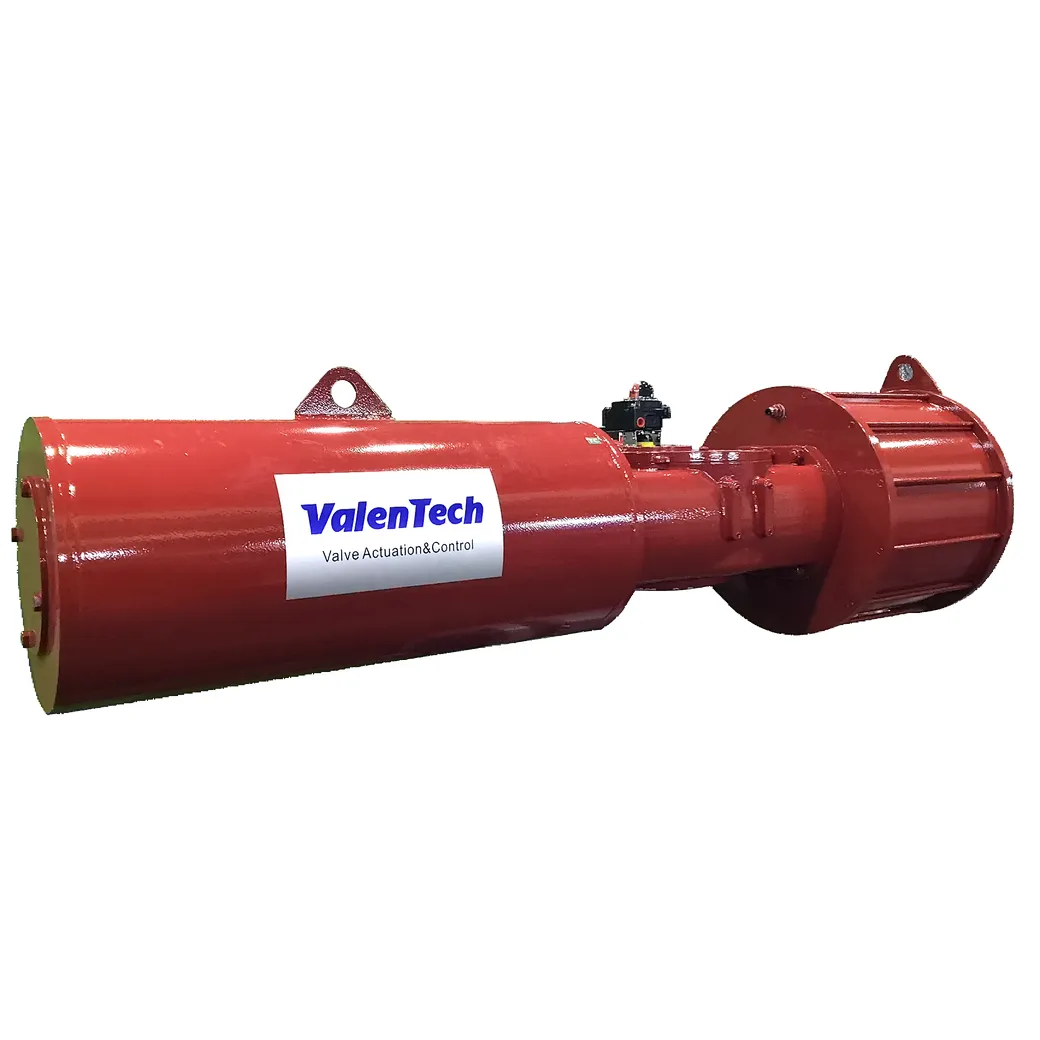
The spring-return function is a mechanical design principle used in single-acting pneumatic actuators. Unlike double-acting actuators that require compressed air to move in both directions, a spring-return actuator uses air pressure to drive one stroke — typically opening a valve — while relying on a set of powerful internal springs to return it to its original position when air pressure is removed.
Here’s how it works:
- Powered Stroke: Compressed air (typically supplied within the standard industrial range of 60–100 psi, as detailed in Valen Tech Co., Ltd.'s guide) enters the actuator cylinder.
- This forces the piston or yoke mechanism to move, rotating the valve shaft to the desired position (e.g., fully open).
- During this stroke, the internal springs are compressed, storing mechanical energy.
- Return Stroke: When the control signal stops and the air exhausts from the cylinder, the stored energy in the springs is released.
- The springs push the piston back, returning the valve to its default position (e.g., fully closed).
This creates a fail-safe action that is entirely mechanical and independent of external power sources.
Why Is "Fail-Safe" Operation Non-Negotiable in Critical Systems?
Because industrial accidents are often not caused by active failures, but by the absence of a safe state during a passive event—like a power outage, control system crash, or physical damage to a pipeline.
A "fail-safe" system is engineered so that when a failure occurs, the system automatically defaults to a condition that minimizes danger. In the context of fluid handling, this usually means stopping the flow of material.
For example:
- If a fire breaks out near a flammable liquid line, a loss of power should cause the isolation valve to close, cutting off fuel.
- If a reactor experiences overpressure, a vent valve should open to release pressure.
- If a cooling water pump fails, a bypass valve might need to open to maintain flow.
Without a fail-safe mechanism, a failure could leave a valve wide open, allowing a hazardous situation to escalate uncontrollably. The spring-return function provides this essential safety net.
How Does It Provide Safety Without Electricity or External Power?
The genius of the spring-return lies in its inherent simplicity and independence.
Consider the typical causes of system-wide failures:
- Power Failure: A storm knocks out the electrical grid.
- Control System Fault: A PLC crashes or loses communication.
- Air Supply Rupture: A hose bursts, causing a sudden drop in compressed air pressure.
In all of these scenarios, a spring-return actuator still functions correctly. Its operation relies solely on the physics of compressed springs, which do not require electricity, data signals, or even a continuous air supply to perform their safety function.
It is a form of passive safety. There are no batteries to die, no software to crash, and no complex logic to fail. The moment the air pressure holding the valve in its powered position is lost, the springs take over and force the valve to its safe state.
This contrasts sharply with electric actuators or double-acting pneumatic actuators, which often require backup systems (like battery packs or air reservoirs) to achieve similar fail-safe behavior—adding complexity, cost, and potential new points of failure.
What Makes It More Reliable Than Electronic or Digital Safety Systems?
While modern digital safety instrumented systems (SIS) are highly sophisticated, they are built on layers of technology that can be compromised.
Electronic systems depend on:
- Stable power supplies
- Functional circuitry
- Intact communication networks
- Correctly programmed logic
Each layer is a potential point of failure. Electromagnetic interference (EMI), voltage surges, software bugs, or cyberattacks can all disrupt an electronic command.
The spring-return function, however, operates on pure mechanics. Its reliability stems from having minimal components and no dependency on external signals.
It cannot be hacked. It doesn't suffer from firmware updates. It isn't affected by radio noise. Its only requirements are proper initial installation and periodic maintenance to ensure the springs haven't corroded or fatigued.
This mechanical robustness makes it ideal for environments where intrinsic safety is paramount, such as zones with flammable gases or dust, where even a tiny spark from an electronic fault could be disastrous.
Can It Be Integrated Into Modern Control Strategies?
Absolutely. The idea that a mechanical safety system is incompatible with modern automation is a myth.
The spring-return actuator integrates seamlessly into advanced control loops through the use of pneumatic positioners and I/P transducers, leveraging the long-established 3–15 psi pneumatic signal standard.
Here’s how it works:
- A modern control system (PLC, DCS, or SCADA) sends an electronic signal (e.g., 4–20 mA) based on process conditions.
- An I/P transducer converts this electrical signal into a proportional 3–15 psi pneumatic signal.
- This low-pressure signal goes to a pneumatic positioner mounted on the actuator.
- The positioner uses the 3–15 psi signal as a "command" to regulate the flow of high-pressure power air (60–100+ psi) to the actuator's cylinder.
- This allows for precise modulating control, moving the valve to any intermediate position for fine process regulation.
Critically, if at any point the air supply is lost—whether due to a compressor failure, a ruptured line, or a deliberate emergency stop—the high-pressure power air exhausts. The 3–15 psi signal may persist, but without the muscle to actuate the valve, the springs activate and return the valve to its safe position.
This integration provides the best of both worlds: precise digital control during normal operations and inherently safe mechanical response during emergencies.
Safety Through Simplicity
The spring-return function enhances system safety not because it is complex, but because it is elegantly simple. It embodies a fundamental engineering principle: when lives and equipment are on the line, the most reliable solution is often the one with the fewest things that can go wrong.
By using stored mechanical energy to guarantee a safe state upon failure, it provides a level of assurance that complex, multi-layered systems struggle to match. It is a testament to the enduring value of robust, mechanical design in an increasingly digital world.
At Valen Tech Co., Ltd., we understand that true innovation respects the fundamentals of safety and reliability. Our commitment is to provide actuation solutions that are not only efficient but also inherently safe, helping you build systems you can trust.




Can a Spring-Return Actuator Be Used for Modulating Control
How Does a Spring-Return Scotch Yoke Actuator Work
Related Article