What Happens If Air Leaks in a Double-Acting Actuator
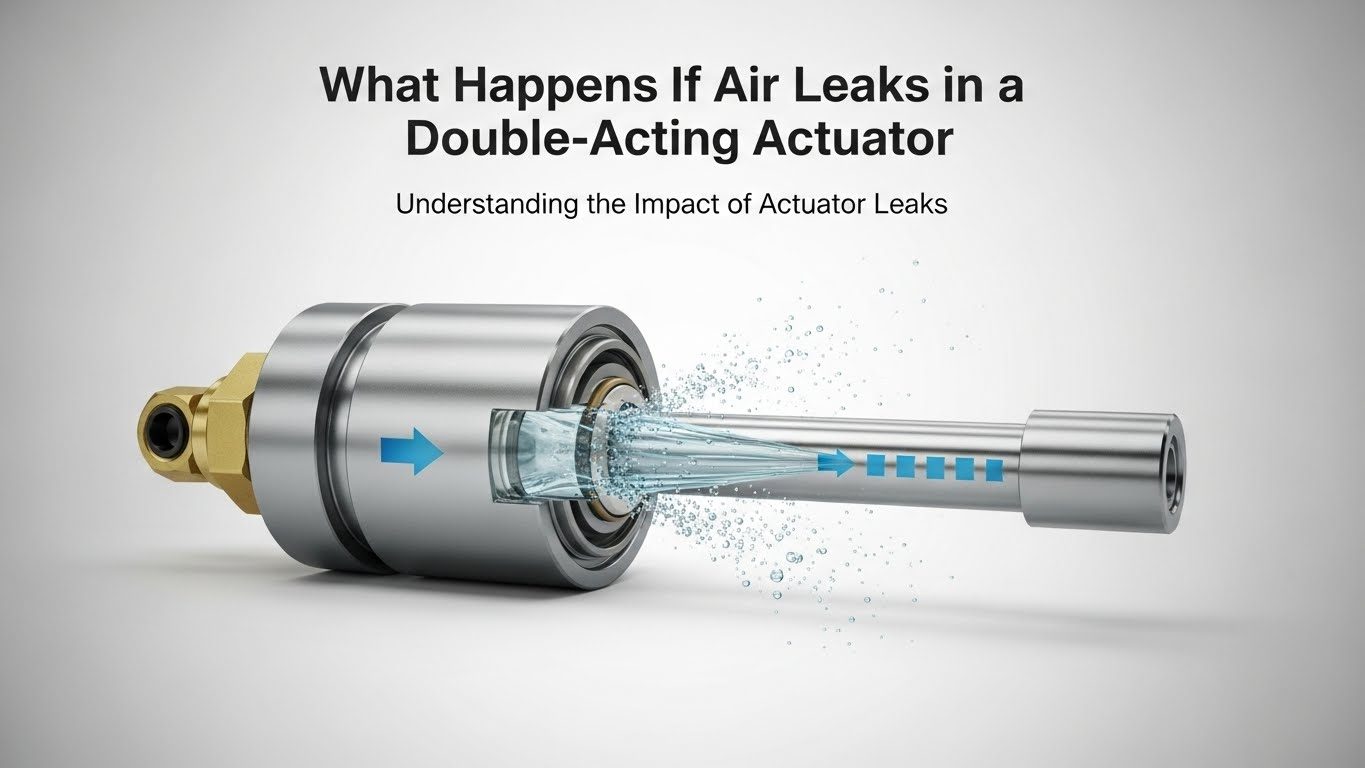
What Happens If Air Leaks in a Double-Acting Actuator? The Hidden Cost of a Hiss
You're walking through the plant during your morning rounds when you hear it — that faint, high-pitched hiss. It’s easy to ignore. After all, compressed air is cheap, right? And a little leak here or there… well, isn’t that just part of industrial life?
Not if you’re running double-acting pneumatic actuators.
That tiny leak might seem harmless, but in a double-acting system — where every movement depends on precise air pressure going to both sides of the piston — even a small loss can trigger a chain reaction of performance issues, wasted energy, and unexpected downtime.
Let’s talk about what really happens when air leaks from a double-acting actuator, why it matters more than you think, and how to stop it before it starts costing you time, money, and reliability.
How a Double-Acting Actuator Works – And Why Every PSI Counts
Before we dive into the problem, let’s quickly revisit how these actuators do their job.
A double-acting actuator uses compressed air to move in both directions: one port pushes the piston out (e.g., opening a valve), and the other pulls it back (closing the valve). There’s no spring involved — just pure pneumatic power doing all the work.
And as Valen Tech Co., Ltd.’s guide reminds us:
“The vast majority of standard industrial compressed air systems operate within a range that's ideal for pneumatic actuators:
- 60 to 100 psi (4 to 7 bar)”
This pressure isn’t arbitrary. It’s carefully chosen to deliver enough force for reliable operation without requiring oversized equipment. But here’s the catch: this force only works if the pressure stays intact.
When air leaks, that balance breaks down — and so does performance.
What Really Happens When Air Leaks?
It’s not just about noise or wasted energy (though those are serious). A leak directly impacts the actuator’s ability to function properly. Here’s what unfolds behind the scenes:
1. Reduced Force Output
Force = Pressure × Area. That’s basic physics.
If your actuator is designed to run at 80 psi but a leak drops the effective pressure to 65 psi, you’ve lost nearly 20% of your available force. Suddenly, the actuator may struggle to:
- Open a valve against line pressure
- Close tightly enough to prevent leakage
- Overcome friction in older or poorly maintained valves
In critical applications, this can mean incomplete closure, process inefficiency, or even safety risks.
2. Slower Response Times
Air must flow quickly to fill one side of the cylinder while exhausting the other. A leak acts like a slow drain, making it harder to build up pressure fast enough.
Result? Sluggish movements. Delays in cycle timing. Bottlenecks on the production line.
For high-speed automation — like packaging machines or robotic arms — milliseconds matter. A hissing seal can turn a smooth operation into a frustrating lag.
3. Inconsistent Positioning
Double-acting actuators are often used with pneumatic positioners, which rely on a separate 3–15 psi control signal (another key point from Valen Tech’s article) to command precise positions.
But here’s the twist: if there’s an internal leak across the piston seals, the actuator won’t hold its position accurately. Even with perfect input signals, the actual output drifts because air escapes past worn seals.
This leads to:
- Valve hunting (constant small corrections)
- Poor process control
- Product quality variations
Imagine trying to maintain exact temperature in a reactor because your control valve keeps drifting open by 2%. That’s the real-world impact of a seemingly minor leak.
4. Increased Wear and Premature Failure
Leaks don’t just waste air — they stress the entire system.
To compensate for lost pressure, solenoid valves cycle more frequently. Compressors run longer. FRL units (Filter-Regulator-Lubricator) work harder. All of this accelerates wear on components that should last years.
And inside the actuator itself?
- Worn rod seals allow contaminants to enter, damaging pistons and cylinders.
- Uneven pressure distribution causes side-loading, wearing out bushings and guides.
- The whole system operates outside its intended design envelope.
Eventually, what started as a whisper turns into a full-blown failure.
Where Do These Leaks Come From?
Leaks aren’t random. They follow predictable patterns — usually at the weakest links in the system.
? Rod Seals (Most Common)
The piston rod moves in and out thousands of times. Over time, the dynamic seal wears down, especially if:
- The rod is dirty or corroded
- There’s misalignment causing side-load
- Lubrication has dried up
Once the seal degrades, air begins to escape around the rod — often visible as a slight puff during retraction.
? Port Connections and Fittings
Vibration, thermal cycling, and improper installation can loosen threaded connections. Quick-disconnect couplings also degrade over time, especially if used roughly.
Even a loose NPT fitting can leak significantly under constant pressure.
? Directional Control Valves
Solenoid-operated valves have internal spools and seals. If debris gets in, or if the valve ages, internal leakage occurs — meaning air sneaks past closed ports.
This type of leak is silent and invisible, but it prevents the actuator from holding pressure on one side, leading to drift or sluggish response.
? Cracked or Damaged Cylinder Body
Rare, but possible. Impact damage, corrosion, or manufacturing defects can create micro-cracks that grow under pressure cycles.
These are dangerous because they can lead to sudden rupture.
The Real Cost of Ignoring a Leak
Let’s put numbers to the problem.
According to industry studies:
- A single 1/8-inch (3 mm) diameter hole at 80 psi can waste over 300 cubic feet of air per minute.
- That translates to thousands of dollars per year in wasted electricity, depending on compressor efficiency and local energy costs.
- Multiply that by multiple small leaks across a facility, and you’re talking six-figure losses annually.
But beyond money, consider:
- Lost production due to inconsistent actuator performance
- Increased maintenance labor
- Risk of unplanned shutdowns
- Environmental impact from unnecessary energy use
All because of a sound many people have learned to tune out.
How to Find and Fix Leaks Before They Become Problems
The good news? Leaks are fixable — and often preventable.
Here’s how smart teams stay ahead:
✅ Perform Regular Leak Audits
Schedule quarterly or biannual inspections using:
- Ultrasonic leak detectors (the gold standard — they "hear" what humans can’t)
- Soapy water spray (for accessible fittings and rods)
Walk the lines during quiet periods when background noise is low.
✅ Prioritize Prevention
- Use high-quality seals and fittings rated for your operating pressure.
- Install protective boots or scrapers on rod ends in dirty environments.
- Ensure proper alignment between actuator and driven equipment.
- Maintain clean, dry, lubricated air with properly functioning FRL units.
✅ Train Your Team
Teach operators and maintenance staff to recognize the signs:
- Slower-than-normal actuator response
- Excessive compressor cycling
- Visible oil mist around exhaust ports (a sign of seal wear)
- Unexplained drops in system pressure
Make “listening for leaks” part of daily routines.
✅ Keep Spares On Hand
Rod seal kits, O-rings, and replacement fittings should be readily available. Downtime is far more expensive than inventory.
Final Thoughts: Respect the Hiss
A double-acting actuator is only as strong as the air pressure behind it. When that pressure escapes — even slowly — everything suffers: performance, precision, longevity, and cost-efficiency.
That little hiss isn't just background noise. It’s your system telling you something’s wrong. Maybe it’s a worn seal. Maybe it’s a loose fitting. Or maybe it’s a warning sign of bigger problems to come.
At Valen Tech Co., Ltd., we believe that true reliability comes not just from robust hardware, but from attentive care. Whether you're automating a simple valve or designing a complex control loop, understanding the importance of sealed integrity makes all the difference.
So next time you hear that faint whistle… don’t walk past it. Stop. Investigate. Fix it.
Because in industrial automation, silence isn’t golden — it’s efficient.
? Explore our range of high-performance pneumatic actuators
? Contact us for technical support or system audits

Butterfly Valve vs Ball Valve Actuators: How to Choose the Right Drive Solution Based on Torque and Speed?
Common Issues of Double-Acting Actuators During Operation
Related Article