Why Use a Spring-Return Scotch Yoke Pneumatic Actuator
Why Use a Spring-Return Scotch Yoke Pneumatic Actuator?
In the world of industrial automation, selecting the right actuator isn't just about making something move — it's about ensuring reliable, safe, and efficient operation under real-world conditions. Among the various types available, the spring-return scotch yoke pneumatic actuator stands out as a specialized solution designed for applications where fail-safe functionality, high torque output, and mechanical simplicity are non-negotiable.
While rack-and-pinion actuators dominate in general-purpose automation, the scotch yoke design offers unique performance characteristics that make it ideal for critical process control systems — particularly in industries like oil & gas, chemical processing, water treatment, and power generation.
Let’s go beyond the basics and explore why engineers specify this particular type of actuator when safety, precision, and system integrity matter most.
What Is a Spring-Return Scotch Yoke Actuator?
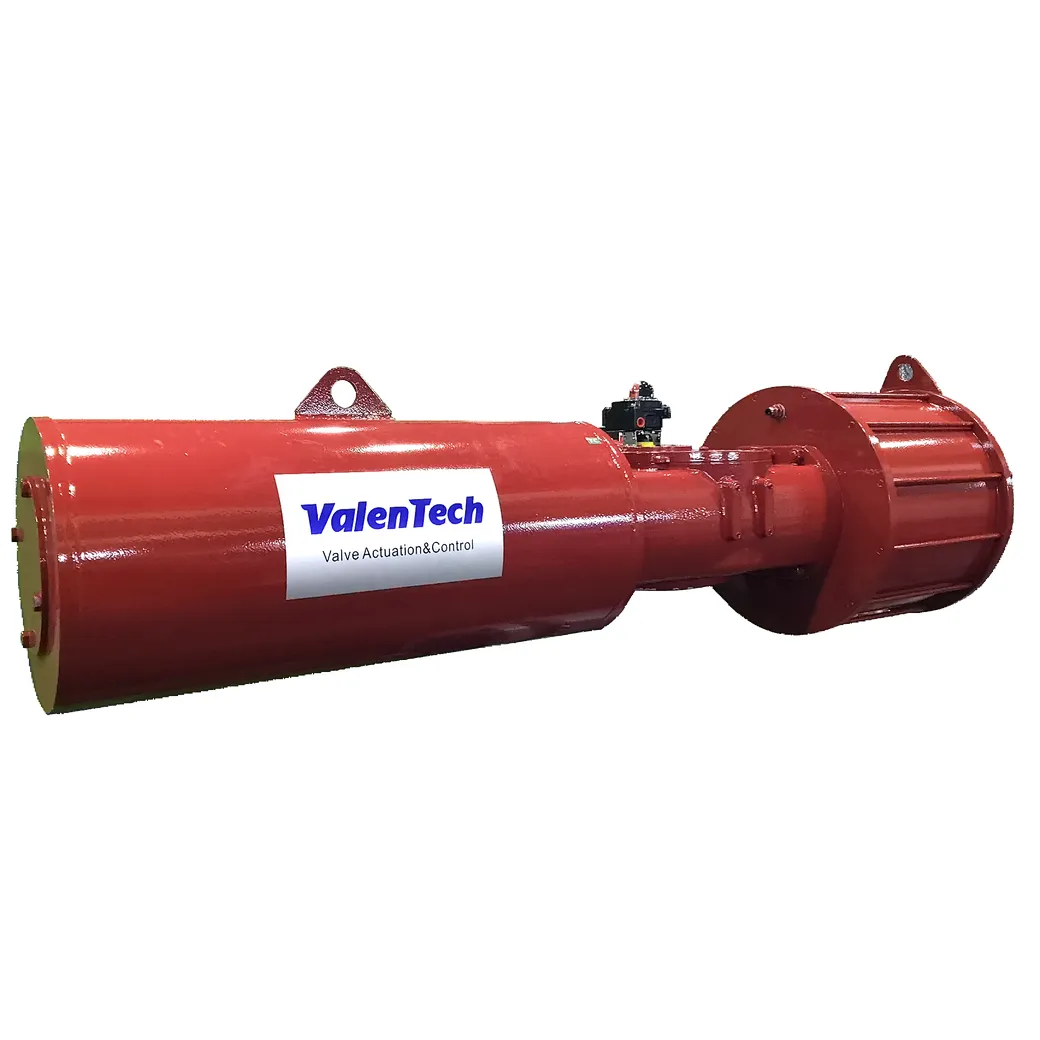
A spring-return scotch yoke actuator is a single-acting pneumatic device that converts linear piston motion into rotary output using a mechanical linkage known as a yoke mechanism. Unlike double-acting designs that use air pressure to move in both directions, this actuator uses compressed air (typically within the standard industrial range of 60–100 psi / 4–7 bar) to drive one stroke — usually opening a valve — while relying on an internal spring pack to return it to its home position when air pressure is released.
The core components include:
- A piston cylinder with pressurized air acting on one side
- A slotted yoke connected to the output shaft
- A pin or crosshead attached to the piston that slides within the yoke slot
- A spring cartridge (on the return side) pre-compressed to store energy
When air enters the powered chamber, the piston moves forward, forcing the pin along the yoke slot, which rotates the shaft by 90°. When the air exhausts, the stored energy in the springs pushes the piston back, reversing the motion.
This design delivers a distinct advantage: inherent fail-safe behavior without requiring external backup systems.
How Does It Work — And Why Is the Mechanism Unique?
To understand the superiority of the scotch yoke, we must examine its kinematics — how motion is generated and transmitted.
The Kinematic Advantage: Torque Profile Tailored to Valve Dynamics
One of the most significant engineering advantages of the scotch yoke lies in its torque profile — the way torque varies throughout the stroke.
Due to the geometric relationship between the sliding pin and the rotating yoke, the torque output is not constant but follows a specific pattern:
- Maximum torque at the start and end of the stroke
- Lower torque in the middle third
This may seem counterintuitive at first — shouldn’t torque be uniform? But consider what happens during valve operation:
| Valve Position | Force Required |
|---|---|
| Fully Closed | High force needed to "break away" from the seat due to seal compression and static friction |
| Mid-Stroke | Lower resistance; dynamic friction only |
| Fully Open → Closing | High force required again to compress seals and achieve bubble-tight shutoff |
The scotch yoke’s natural torque curve matches this demand perfectly. It provides peak force exactly when it’s needed most — overcoming initial breakaway torque and ensuring positive closure.
Compare this to a rack-and-pinion actuator, which produces nearly constant torque across the stroke. While predictable, it doesn’t optimize mechanical efficiency for typical quarter-turn valves.
Why Choose a Spring-Return Design Over Double-Acting?
This question cuts to the heart of process safety engineering.
A double-acting actuator uses air pressure to open and close the valve. If air pressure fails — due to compressor shutdown, line rupture, or control system fault — the actuator typically holds its last position ("fail-last"). In many cases, this can leave a hazardous fluid flowing unchecked.
A spring-return actuator, however, defaults to a safe state upon loss of air:
- Fail-closed: Prevents uncontrolled release of flammable, toxic, or high-pressure media
- Fail-open: Maintains cooling flow or ventilation even during emergencies
This makes it essential for:
- Emergency shutdown (ESD) systems
- Fire protection deluge lines
- Toxic gas isolation
- Overpressure relief circuits
- Any application governed by functional safety standards (e.g., SIL-rated systems)
It’s not just a feature — it’s a fundamental principle of inherently safe design.
Moreover, because the return function relies on mechanical springs rather than electrical solenoids, battery backups, or hydraulic accumulators, the system remains operational even during total power failure.
What Makes the Scotch Yoke More Efficient Than Other Designs?
Beyond safety, the scotch yoke offers several performance and integration benefits:
✅ Compact Size for High Output Torque
Because torque multiplication comes from mechanical leverage rather than gear reduction, the scotch yoke can generate very high torque outputs in a relatively compact housing.
For example, a small-body scotch yoke actuator might deliver the same torque as a much larger rack-and-pinion unit — saving space in crowded piping racks or tight enclosures.
This also reduces weight, minimizing stress on valve stems and supports.
✅ Fewer Wear Points and Higher Reliability
Unlike gear-based systems, there are no meshing teeth to wear down, lubricate, or misalign. The primary moving parts are the piston, sealing elements, and yoke interface — all of which are robustly engineered and sealed.
Fewer wearing surfaces mean:
- Longer service life
- Reduced maintenance intervals
- Less sensitivity to contamination
- No need for periodic gear backlash adjustment
Additionally, modern units often use self-lubricating materials (like PTFE-coated pins or composite bushings), further reducing dependency on external lubrication.
Can It Be Used for Modulating Control?
Yes — and this is often misunderstood.
Basic spring-return actuators operate in on/off mode: full open or full closed. However, when paired with a pneumatic positioner, they become fully capable of proportional or modulating control.
Here’s how it works:
The positioner receives a low-pressure control signal — historically and still commonly the industry-standard 3–15 psi pneumatic signal (as referenced in Valen Tech Co., Ltd.'s article). This signal represents a percentage of desired position:
- 3 psi = 0% (fully closed)
- 15 psi = 100% (fully open)
- 9 psi = 50% (halfway)
The positioner interprets this signal and regulates the higher-pressure power air (60–100 psi) going to the actuator’s powered chamber. It dynamically balances air supply and exhaust to hold the valve precisely at any intermediate position.
Even more advanced models integrate electro-pneumatic I/P transducers, allowing them to receive electronic signals (like 4–20 mA) while still driving a purely pneumatic actuator — combining digital control with intrinsic safety.
Crucially, even in modulating service, the fail-safe function remains intact. If the control signal or air supply is lost, the spring returns the valve to its safe position.
This dual capability — precise modulation plus automatic safety response — makes the spring-return scotch yoke uniquely versatile.
Are There Limitations? Yes — And They Matter
No technology is perfect. Understanding the drawbacks ensures proper application.
❌ Not Ideal for High-Cycle Applications
Every cycle subjects the internal springs to full compression and decompression. Over time, metal fatigue sets in, leading to reduced return force or eventual failure.
For processes requiring thousands of cycles per day (e.g., packaging lines), a double-acting actuator is better suited, eliminating spring wear entirely.
❌ Potential for Spring Degradation in Harsh Environments
Exposure to extreme temperatures, moisture, or corrosive atmospheres accelerates spring degradation. Regular inspection and preventive replacement are necessary in such conditions.
Some manufacturers offer corrosion-resistant coatings or stainless steel spring packs to mitigate this risk.
❌ Slightly Slower Return Speed
Since the return stroke depends on spring force rather than pressurized air, it may be slower than the powered stroke — especially if the spring has weakened over time.
This delay could affect process timing in fast-response systems.
When Should You Specify a Spring-Return Scotch Yoke Actuator?
You should strongly consider this actuator type if your application involves:
| Requirement | Why It Fits |
|---|---|
| Fail-safe operation required | Provides automatic valve movement on air loss — essential for ESD systems |
| High breakaway or closing torque needed | Peak torque at stroke ends matches valve dynamics perfectly |
| Hazardous or explosive environments | No sparks; compatible with Class I Div 1/2 areas |
| Space-constrained installations | High torque density allows smaller footprint |
| Need for both on/off and modulating control | Compatible with positioners while retaining safety |
| Reliance on simple, proven technology | Mechanical reliability beats complex electronics in harsh settings |
Common applications include:
- Isolation valves on hydrocarbon pipelines
- Blowdown valves in refineries
- Cooling water shutoffs in emergency scenarios
- Vent or flare line controls
- Chemical feed isolation
Engineering Confidence Through Simplicity
The spring-return scotch yoke pneumatic actuator is not just another component — it’s a deliberate choice for engineers who prioritize system resilience, process safety, and long-term reliability.
It combines mechanical ingenuity with fail-safe assurance, delivering high performance where it matters most.
At Valen Tech Co., Ltd., we recognize that true innovation isn’t always about complexity — sometimes, it’s about mastering the fundamentals. Whether you're upgrading legacy systems or designing new installations, our team provides expert guidance and high-quality actuation solutions built for real-world demands.
👉 Explore our pneumatic actuator product line
👉 Contact us for technical support or custom configurations
Because in critical operations, the right actuator doesn’t just work — it protects.




What Makes the Scotch Yoke Unique
How to Select a Suitable Motor Actuator Ball Valve?
Related Article